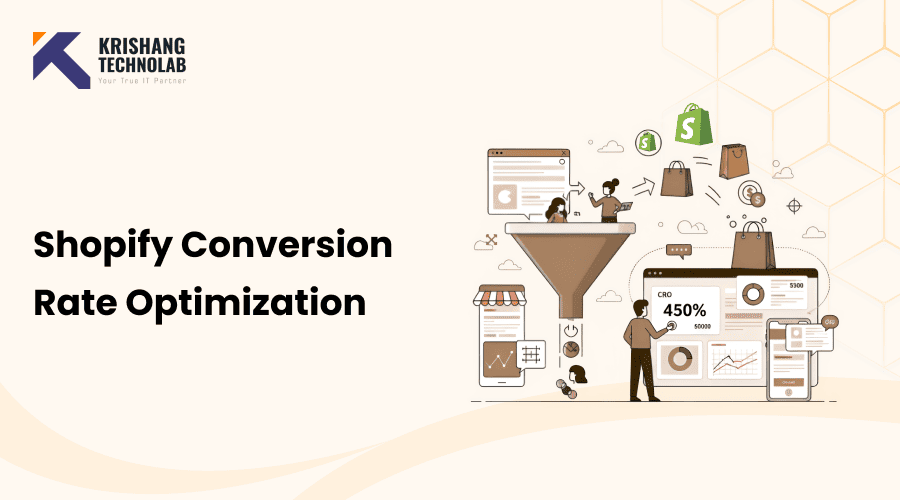
Quick Overview: Learn how to use Shopify conversion rate optimization techniques to increase sales and income. This blog shows you how to increase Shopify conversion rate, improve the user experience, optimize product pages, and do A/B testing to boost your Shopify conversion rate.
It’s important to get people to your store, but the real goal is to turn those visitors into customers. This is where Shopify conversion rate optimization becomes very important. Many store owners have a Shopify low conversion rate even after spending money on ads and marketing. Without proper Shopify conversion optimization, visitors may leave your store without making a purchase.
The goal of conversion rate optimization (CRO) is to make your website better so that more people do things like buy something or add items to their cart. Good website conversion optimization strategies can help increase Shopify conversions and make the most money from the traffic you already have.
Businesses can increase Shopify conversion rate and overall performance by improving the design of their store, their product pages, and the checkout process. This blog will show you how to increase conversion rate Shopify stores using proven CRO strategies, tools, and techniques.
What is Conversion Rate Optimization (CRO)?
The process of conversion rate optimization (CRO) is making a website better so that more visitors do what you want them to do, like setting up a successful online store. Some of these actions could be buying something, signing up for a newsletter, or putting items in a cart.
Website conversion optimization for e-commerce businesses is all about getting visitors to buy something. Because of this, businesses can make more money from the traffic they already have.
Shopify conversion rate optimization makes shopping better for people who own Shopify stores. This means that more people who visit the site buy something. Businesses use Shopify conversion optimization strategies to increase Shopify conversions, not just to get more people to visit their sites. This will eventually lead to more sales.
How Conversion Rate Optimization Works
CRO is all about figuring out how people use your store. It also helps you find problems that keep people from buying something.
Businesses can find out where visitors leave by looking at how they use their websites. After that, they can make key pages to increase conversion rate Shopify stores more effectively.
Some common ways to improve CRO are:
- Improving website design and user experience
- Optimizing product pages and descriptions
- Simplifying the checkout process
- Improving page speed and mobile usability
- Testing different layouts using A/B testing
These strategies work together to improve Shopify conversion rate. They also help fix problems that often cause a Shopify low conversion rate.
Also Read About: How can loyalty programs help reduce drop-offs and increase Shopify conversions?
Shopify Conversion Rate Formula
The Shopify conversion rate shows what number of visitors actually buy something. A simple method is used to figure it out:
Conversion Rate = (Number of Conversions ÷ Total Visitors) × 100
For example:
- Visitors: 1,000
- Orders: 30
Conversion Rate = 3%
Store owners can get a better idea of how their store is doing by keeping an eye on this metric on a daily basis. In addition, it helps them find chances for conversion optimization Shopify strategies. Because of this, companies can work to increase Shopify conversion rate over time.
Why is Conversion Rate Optimization Important?
Conversion rate optimization (CRO) helps businesses make more sales from the traffic they already have on their website. Store owners can make their websites better instead of spending more money on ads. The result means more sales and more money for Shopify.
Shopify conversion rate optimization makes it easier for people to shop at online stores. People can look at products without getting confused. They can also figure out what to buy. A simple website makes people trust you. Customers are more likely to finish their purchases because of this.
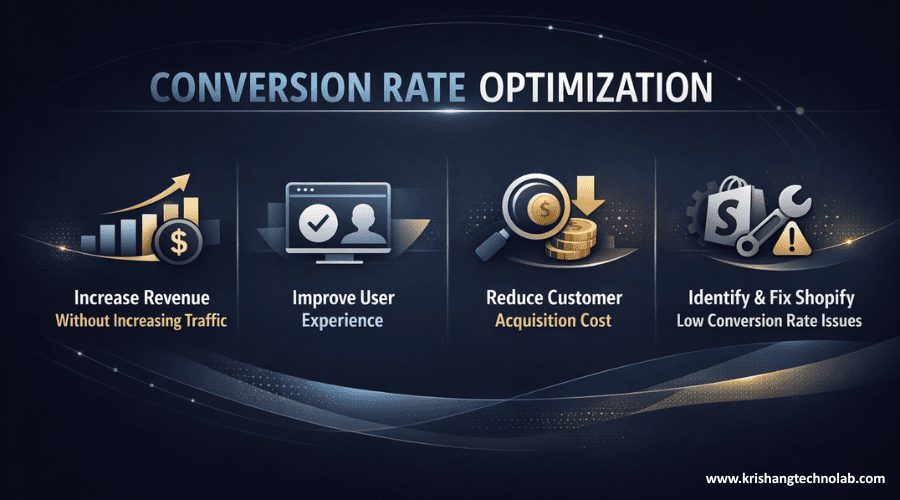
Increase Revenue Without Increasing Traffic
A key benefit of Shopify conversion optimization is that you can grow without spending more on marketing. To sell more, businesses don’t need more customers.
Store owners can make the user experience better by improving product pages and set up Shopify payments and checkout process. These changes make it easier for customers to buy. Shopify’s conversion rate goes up as a result. Companies can sell more with the same number of visitors.
Improve User Experience
Well-optimized websites facilitate easy shopping. CRO makes it easier to find your way around, speeds up pages, makes them easier to use on mobile devices, and gives you more information about products.
These changes make the site simple to use. Customers can get what they need right away. They can walk through the store without any trouble. This helps improve conversion rate Shopify stores and reduces bounce rates. A well-structured layout and clear visual hierarchy are also important parts of Shopify conversion-focused design that help improve conversion rate Shopify stores and reduce bounce rates.
Reduce Customer Acquisition Cost
Many online stores are seeing their marketing costs go up. The cost per customer goes down when more people buy.
Effective conversion optimization Shopify strategies help businesses get more out of their marketing campaigns. This means that stores can make better use of their money.
Identify and Fix Shopify Low Conversion Rate Issues
Some stores have many customers but don’t sell much. This may show a Shopify low conversion rate. CRO helps you find things that keep customers from buying.
For instance, the site might be slow. The pages for products might not be very good. The process of checking out might be challenging. Fixing these issues can increase conversion rate Shopify stores and improve overall store performance.
Conversion Rate Calculator: How to Measure and Improve Your CRO Efforts
Measuring your Shopify conversion rate is essential for effective Shopify conversion rate optimization. You can’t tell if your conversion optimization Shopify strategies are working if you don’t keep track of how well they are doing.
Shopify Conversion Rate Formula
The Shopify conversion rate is calculated using this formula:
Conversion Rate = (Number of Conversions ÷ Total Visitors) × 100
Example:
- Visitors: 5,000
- Orders: 150
- Conversion Rate = 150 ÷ 5000 × 100 = 3%
This easy math problem helps you keep track of how well your store is doing and find ways to improve Shopify conversion rate.
Why Use a Conversion Rate Calculator?
With a conversion rate calculator, you can quickly see how well your store is doing and compare it to other stores. It helps answer important questions like:
- Is my store doing better than most?
- Do I need Shopify conversion optimization?
- How well are my current CRO strategies working?
Shopify Conversion Rate Benchmarks
Knowing what benchmarks are can help you with your CRO efforts:
- 1% or less – Low conversion rate (Shopify low conversion rate)
- 2% – Average conversion rate
- 3% – Good conversion rate
- 4%+ – Excellent conversion rate
You can ensure the effectiveness of your website conversion optimization efforts by consistently monitoring and measuring your Shopify conversion rate. This will also help you plan ways to increase Shopify conversions.
Key Elements and Strategies for Conversion Rate Optimization
Shopify conversion rate optimization (CRO) helps more people who visit your site do what you want them to do. These actions could be buying something, signing up for a newsletter, or putting items in the cart. Businesses can make the shopping experience better by looking at how people shop and making it easier. Because of this, they can get more people to buy things on Shopify and make more money.
The most important parts of a store are what effective website conversion optimization focuses on. It also employs data-driven strategies. These strategies also help users finish their purchases.
Key Elements of Shopify CRO
To get the most conversions, pay attention to these areas. This is crucial for landing pages, product pages, and checkout sections:
- Call to Action (CTA): Use CTAs that are short, clear, and stand out from the rest of the page. This tells people what to do following this. Strong CTAs also help you get more sales on Shopify.
- Page Load Speed: Bounce rates go down on fast pages. People don’t like slow pages. So, using Shopify speed optimization services can also help you get more sales on Shopify.
- Mobile Optimization: Most of your online store’s traffic comes from mobile devices. Please ensure your store is responsive. It should be simple to find your way around. It should be simple to tap the buttons. Businesses focusing on mobile optimization for Shopify stores see higher engagement and increased sales.
- Trust Signals: Add reviews, testimonials, case studies, and secure payment badges to build trust. Trust signals make something seem more trustworthy. Because of this, they help Shopify’s conversion rate by encouraging people to buy things.
- Simplified Navigation: Cut down on choices that aren’t needed. Users can quickly scan and find products on simple pages. This neat layout also helps with Shopify website launch checklist principles to optimize conversions.
- Data-Driven Insights: Use heatmaps, session recordings, and analytics to find drop-off points. These insights also make the experience better for users. They also do a good job of increasing Shopify conversions.
Core Strategies for Shopify CRO
To increase the Shopify conversion rate, you need structured tactics that are based on evidence. Some of these are:
- Define Goals & Measure Baselines: Monitor when customers complete a form, purchase anything, or sign up for an email. This helps us figure out how things are going right now. It also helps with making changes in the future.
- Conduct User Research: Add user feedback to statistics data. This shows where the pressure is. It also shows places where Shopify conversion efficiency could be improved.
- A/B Testing (Split Testing): Check out the highlights, pictures of the products, layouts, and calls to action. These tests also help make plans better. So, they raise the transaction rate on Shopify.
- Reduce Friction: Make it easier to check out. Get rid of steps and form areas that aren’t needed. Shopify’s conversion rate goes up and sales go up when there are fewer problems.
- Personalization: Based on how a user acts, show them information, product suggestions, or deals. Personalization also makes Shopify sales go up. Also, it helps people use things better.
- Create Urgency: Limited-time offers, low stock warnings, and exclusive deals entice buyers to act quickly. You can also create a coming soon page Shopify; to build anticipation and further increase the conversion rate of your Shopify store.
These elements used in conjunction with one another allow store owners to continually grow their store’s conversion rate and provide your customers with an enjoyable shopping experience leading to growth within the eCommerce market.
Top Conversion Rate Optimization Tools to Skyrocket Your Shopify Sales
To get the most out of your Shopify store, you need to use the right tools. These tools show what people do when they come to your site. They also assist in identifying areas where issues arise. They also help with strategies that boost Shopify conversions.
Businesses can boost their Shopify conversion rate by using analytics, testing, and personalization tools. Because of this, they can make more money from the traffic they already have.
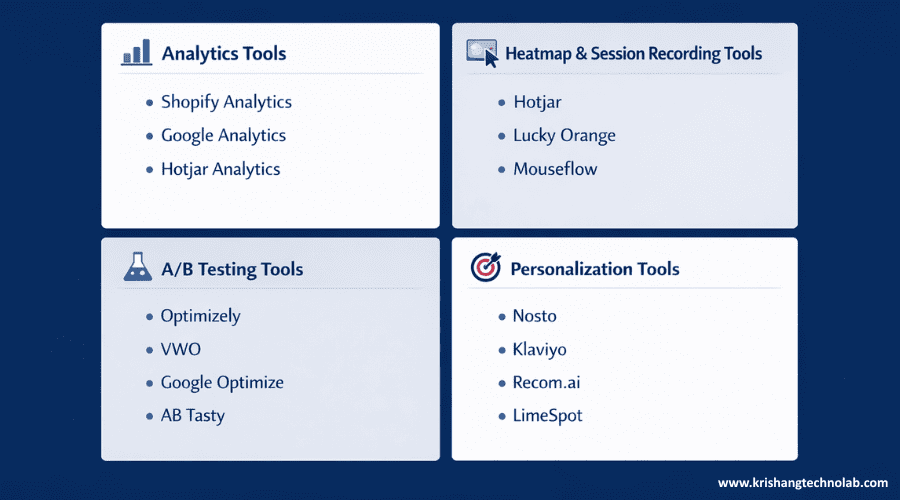
Analytics Tools
Analytics tools keep track of sales, page views, bounce rates, and where traffic comes from. Shopify store owners often use these tools:
- Shopify Analytics – Built-in analytics to keep track of visits, sales, and conversion rates.
- Google Analytics – Shows how users are behaving and keeps track of the sales process.
- Hotjar Analytics – It shows how people use your store.
These tools help you find places where you can improve your Shopify conversion rates. They also support data-driven decision-making.
Heatmap and Session Recording Tools
Heatmaps and session recordings show what people do when they visit your store. They show where there might be problems that could lead to a low conversion rate on Shopify. Some popular tools are:
- Hotjar – Heatmaps, videos of sessions, and polls for getting feedback.
- Lucky Orange – Live data, recording of sessions, and tracking of clicks.
- Mouseflow – Playback of sessions and form statistics.
These tools give you ideas that can help you get more sales on Shopify. For instance, they can make product pages, navigation, and the checkout process better. Also, they help stores get better.
A/B Testing Tools
You can use A/B testing tools to test headlines, product pictures, layouts, and buttons that tell people what to do. It assists you in determining what is most effective. Some important tools are:
- Optimizely – Better A/B tests and customization.
- VWO (Visual Website Optimizer) – Variations and keeps track of how they’re doing.
- Google Optimize – Google Analytics has an A/B testing tool that you can use for free.
- AB Tasty – The goal of split testing was on e-commerce conversions.
These tools help you use data to improve your Shopify conversion strategies. So, over time, they help raise the conversion rate on Shopify.
Personalization Tools
Personalization tools show users product recommendations, articles, or deals that are relevant to them based on how they use the site. This increases conversions and engagement. Some important tools are:
- Nosto – AI-powered product recommendations.
- Klaviyo – Customized ads via email and text message.
- Recom.ai – Shopify has a tool that recommends products.
- Limespot – Personalized buying experience to get more people to buy from Shopify.
With these conversion rate optimization tools, Shopify store owners can find problems and try out possible answers. In addition, they have a planned, data-driven way of improving their Shopify sales rates all the time.
Effective Conversion Rate Optimization Process for Shopify
To improve your Shopify sale rate, you need a clear process. It helps companies get more Shopify sales. It also shows places where the exchange rate is low. Conversion rates get better over time when you stick to a process.
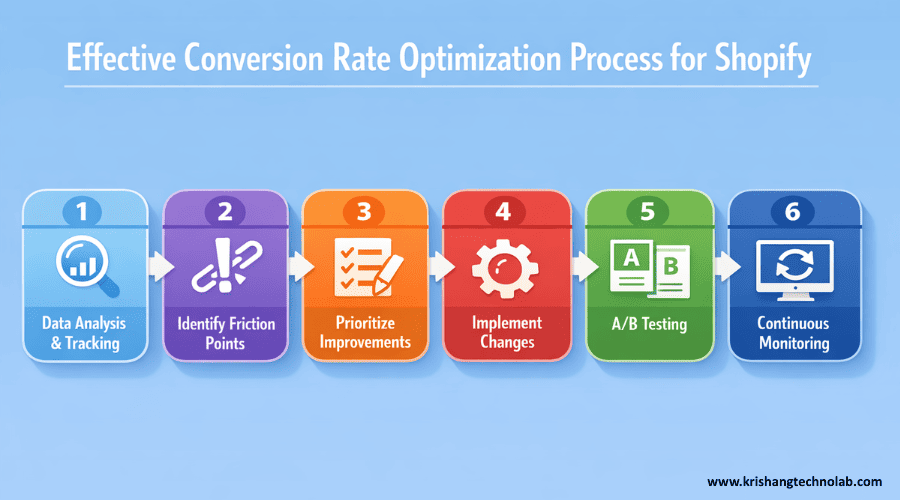
Step 1: Data Analysis & Tracking
To begin, please gather the information from your store. Google Analytics, Hotjar, and Shopify Analytics can all help you. Track visitors, page views, bounce rates, and the steps you take to check out. This information shows how people use your store. It also shows how to get more sales. A Shopify store audit can help you figure out how visitors behave, where they leave, and how to get them to convert more.
Step 2: Identify Friction Points
Next, look for places where guests are having trouble. This could be pages that load slowly, choices that are hard to understand, product pages that don’t show enough information, or a checkout process that is hard to complete. When you fix these issues, Shopify’s conversion rate goes up. In turn, the improved performance makes shopping easier for people.
Step 3: Prioritize Improvements
Problems don’t always have the same effect on changes. Look at the improvements that will have the most effect. Look at how much money you can make, how easy it is to fix, and how the users feel. Shopping Cart Hero can speed up the rate of change this way.
Step 4: Implement Changes
Once you’ve established your goals, you need to implement the necessary changes. Change the look of the product pages, make it easier to check out, make the mobile view better, or add trust signs like reviews or security badges. In many cases, businesses hire Shopify experts to implement these technical improvements, including adding pages in Shopify, to optimize store performance. Because of this, things get better faster.
Step 5: A/B Testing
Try out different headlines, pictures, page layouts, and calls to action. This shows which version is the best. Then, A/B testing gives your strategies for optimizing conversions on Shopify a data-driven basis. It also helps Shopify sales grow over time.
Step 6: Continuous Monitoring
There is no end to conversion optimization. Keep an eye on performance, run tests, and look at the results. Also, keeping an eye on things often makes strategies better and fixes new problems. The conversion rate for Shopify keeps going up. Lastly, such an approach helps e-commerce businesses do well in the long run through proper Shopify store maintenance.
When to Hire Shopify CRO Experts
To get big results in Shopify conversion rate optimization, you may need to hire a professional. Working with experts can also help things grow faster. Experts make fewer mistakes and use advanced methods to boost Shopify conversions. Companies can hire Shopify developers to make their sites look better and work better. They might also hire Shopify experts to help them with advanced CRO strategies and store optimization.
Working with a Shopify development company will give you professional upgrades. A Shopify website design and development agency can make the checkout, product pages, and overall user experience better. Shopify experts provide specialized services to help you optimize your Shopify store. They help you raise your Shopify conversion rate faster than if you tried to make all the changes yourself.
Conclusion
Shopify conversion rate optimization is a way to help an online store grow. Don’t just think about traffic. Store owners should use strategies to raise the conversion rate on Shopify instead. Improving the design of your store can help you get more sales. Results also get better when you make product pages and pages load faster. You can find out what works best by doing A/B testing. CRO tools can help Shopify stores get more sales and make more money. Companies that want to grow quickly can hire professionals who know what they’re doing. Using Shopify development services makes your store work better. It also helps you get results faster when you hire Shopify experts. Your store keeps getting better with ongoing testing, analysis, and optimization. These steps help Shopify make more sales and improve overall performance.
Frequently Asked Questions
What is Shopify conversion rate optimization and why is it important?
The process of improving your store is called Shopify conversion rate optimization (CRO). It makes it easier for more people to do things like buy things, sign up for newsletters, or add things to their cart. Also, if your store gets a lot of visitors but not many sales, that’s money lost. CRO can help you make more money without spending more on marketing. It also improves the experience for the user. The result means that more people who visit become paying customers.
How can I increase Shopify conversion rate for my online store?
You can get more people to buy from your Shopify store by making your product pages better, speeding up your website, and making the checkout process easier. Adding trust signals, such as reviews and security badges, also helps. Clear calls-to-action (CTAs) and mobile optimization both help conversions. A/B testing and personalized recommendations are two examples of data-driven strategies that can help you figure out what works best. Then, over time, Shopify’s conversion rates get better.
Why is my Shopify store experiencing a low conversion rate?
There are many reasons why the conversion rate might be low. Slow page loading, a poor mobile experience, a complex checkout process, unclear product descriptions, or weak CTAs often contribute to this. Use analytics and heatmaps to look at your store and find problems. Next, use the right Shopify conversion optimization strategies to fix any problems. This procedure leads to more engagement, fewer people leaving their carts, and more sales.
How to improve Shopify conversion rate using CRO strategies?
Use tried-and-true CRO methods to boost your Shopify conversion rate. Make product pages better, make pages load faster, improve mobile responsiveness, and add trust signals. Also, do A/B testing, keep an eye on how users act, and make product suggestions that are specific to each user. These strategies also make it easier for visitors to do something. So, sales and conversions go up.
What tools can I use for Shopify conversion rate optimization?
There are several tools that can help you make your Shopify store better. Shopify Analytics and Google Analytics are examples of analytics tools that keep track of traffic, sales, and how people use your site. Tools like Hotjar show you how people use your store. You can use A/B testing tools like Optimizely and VWO to try out different layouts and calls to action (CTAs). Finally, personalization tools like Nosto or Klaviyo give you product suggestions that are just right for you. This helps Shopify get more sales.
Found this post helpful? Don't forget to share it with your network!