Quick Overview: Standard Shopify themes work at first, but growth exposes their limits. This blog covers the clearest signs you need custom Shopify development, from app overload to checkout bottlenecks, plus the benefits, best practices, and key questions to ask before investing in custom Shopify development for your store.
Shopify is a popular platform for building online stores. It has stores of every size. Used by small startups. International brands also use it. Most companies start with a ready-made theme and a couple of apps. This is a fast setup. It’s affordable. Easy to ignite.
But growth changes things. The standard tools start to crack. Pages are slower to load. Workflows get complicated. The brand begins to resemble any other store on the platform. This is where custom Shopify development is the smarter way forward.
Custom Shopify development enables businesses to grow with more flexibility, speed and scale. That’s something pre-made themes can’t give you. A custom store is born out of real business needs. You don’t have to twist your business to fit the software. In this blog, we’ll explore 10 clear signs your store has outgrown its standard setup. We also discuss the advantages, best practices, and key questions to ask before you begin a project.
What Is Custom Shopify Development?
Custom Shopify development is all about building features, themes and integrations for your business. Perhaps your needs are bigger than a theme or an app. So a development team writes custom code to fit your exact workflow and business goals. This is not the same as just a Shopify customization. Basic customization means changing colors, fonts or swapping a few sections in an existing theme. It also covers choosing the right Shopify theme for your store.
Custom Development vs. Shopify Themes
There are two methods to create a Shopify store. Each option is used differently.
Customising a theme is a change to an existing template. And custom coding adds new features. App based solutions also depend on third party tools. Headless commerce gives you more control by decoupling the frontend from the Shopify backend. So, many brands are using more than one approach. They choose what suits them.
| Approach | Best For | Flexibility | Maintenance |
| Theme Customization | Small stores needing quick visual changes | Low | Easy |
| App-Based Solutions | Adding specific features fast | Moderate | Can get complex with many apps |
| Custom Coding | Unique workflows and features | High | Requires ongoing developer support |
| Headless Commerce | High-traffic, design-heavy brands | Very High | Requires a skilled development team |
Who Should Consider Custom Shopify Development?
This approach makes the most sense for growing brands, enterprise businesses, B2B stores and high-volume retailers. It applies for any company with workflows that don’t fit a standard mold. If your operations are more complex than “browse, add to cart, checkout,”, then custom Shopify development services are worth a look. The advantages of Shopify store development become clearer once you compare both paths.
Why Businesses Outgrow Standard Shopify Stores
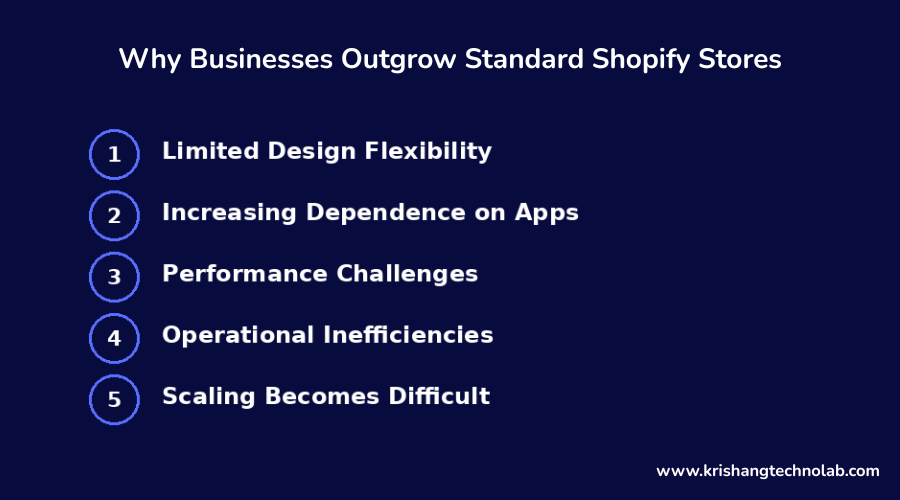
The default Shopify setup is fine, at first. But over time, common problems will start to arise. The design flexibility is limited. Apps stack up. Performance is slow. Daily tasks are more difficult. Scaling is hard. If you relate to any of these issues, consider custom Shopify development.
10 Signs Your Business Needs Custom Shopify Development
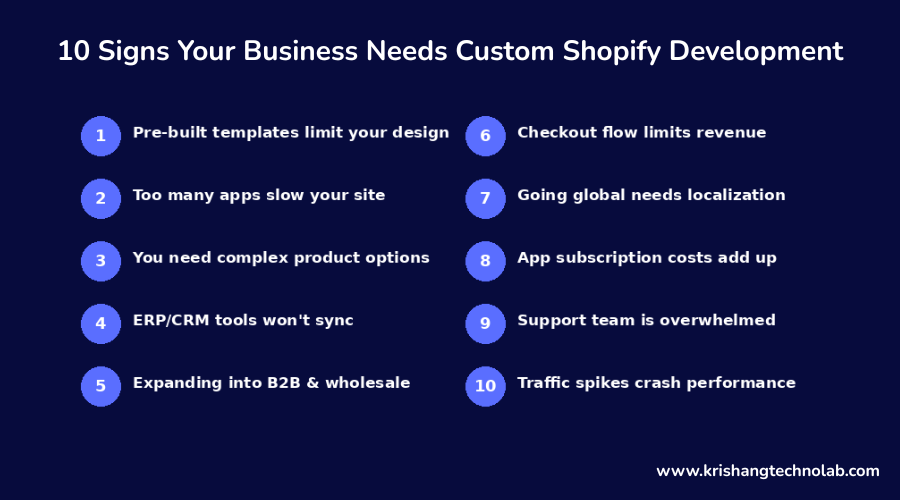
Each of the signs below points to a particular limitation in typical Shopify setups so you can spot the one place where custom development could beef up your store.
1. You’ve Hit the Creative Limits of Pre-Built Templates
Does your website look like a bunch of other sites? Your theme might be holding your brand back. Pre-build templates limit your layout options. They also limit the way customers move through the buying journey. With a custom UI/UX design, we can design a store that really represents your brand identity instead of using someone else’s template. It also assists in improving the Shopify store navigation for a better customer experience.
2. A Bloated List of Third-Party Apps Is Slowing Your Site
Apps are handy. But too many apps drag down page speed. Every app adds an extra code. Apps can also clash with each other, creating maintenance headaches. Slow core web vitals also hurt your Google rankings. These capabilities are built right into your store with Shopify custom development. This cuts the bloat and improves Shopify performance optimization.
3. You Need Complex Product Options or Personalization
Standard product pages aren’t built for everything. Think about product configurators, personalized engraving, bundle builders or dynamic pricing. Another example is conditional logic. Custom Shopify features for online stores can do it for this kind of personalization for your products. No more pushing customers through clunky workarounds.
4. Your ERP, CRM, or Inventory Tools Won’t Sync Properly
Manual data entry is a red flag. Inventory mismatches. Order sync issues too. It means your backend systems aren’t talking to each other. The solution to these problems is custom API integrations. Automated workflows solve this issue as well. They connect Shopify with your ERP or CRM. Your team isn’t staring at spreadsheets all day.
5. You’re Expanding into Complex B2B and Wholesale Selling
Selling B2B and wholesale presents particular difficulties. Customer-specific pricing. Another is volume discounts. Add company accounts, purchase orders, wholesale catalogues and restricted products to the list. Standard Shopify themes are not built for these workflows. You can add these B2B features to your store experience with custom Shopify store development.
6. The Standard Checkout Flow Is Limiting Your Revenue
A strict checkout process costs you money. It means lost opportunities to upsell. That’s lost sales. Helpful custom payment methods. And so are the advanced shipping rules and the smooth checkout experience. Together they increase conversion rates. A custom checkout experience can make a measurable difference in revenue, where your Shopify plan allows it. Setting up Shopify payments and checkout correctly is the first step towards that improvement.
7. Global Scaling Requires Localized Storefronts
International selling is more than just shipping abroad. You require multilingual support. You need multi-currency support as well. Add regional pricing, local payment gateways, tax compliance and country-specific shipping rules. A custom, responsive Shopify store designed for multi-currency support can effectively manage all these requirements.
8. Monthly App Subscription Fees Are Skyrocketing
Many apps are paid for by many stores. Each app does a little of what one custom feature could do. Those SaaS costs add up fast as the months go by. Compare the long-term ROI and the picture becomes clear: custom Shopify apps are often cheaper than years of overlapping subscriptions.
9. Your Customer Support Team Is Overwhelmed by Manual Workflows
Are you doing order processing manually? Are they repeating the same questions customers ask? Handling returns and updating inventory manually also takes time. That’s where workflow automation comes to the rescue. Shopify automation reduces errors. It also gives a better overall customer experience.
10. High-Volume Traffic Spikes Crash Your Store’s Performance
Flash sales should increase revenue, not crash your site. Same goes for seasonal campaigns. Slow loading pages during high traffic means poor server performance. They also mention that the current architecture is not optimised. Scalable Shopify development solutions handle these spikes. Shopify Plus Development and Headless Shopify. Know what plan is best for your traffic by reading Shopify vs Shopify Plus.
Benefits of Custom Shopify Development
The benefits of custom development are obvious:
- Creates a unique brand experience
- Enhances website performance
- Reduces dependence on third-party apps
- Automates business processes
- Works seamlessly with external services
- Grows effortlessly as your business expands
- Improves SEO and Core Web Vitals
- Strengthens security and reliability
- Maximizes long-term ROI
Over time these benefits build up. This is why many growing brands are turning to custom Shopify development, often after seeing the results of simple design tweaks that boost Shopify conversions on their store.
Custom Shopify Development vs. Standard Shopify Solutions
The table below compares standard Shopify setups with custom development. The following table compares the two options. It covers design, features, speed, scalability, integrations and price. Also, it explains how each of the options influences the cost of Shopify website development. So you can compare both solutions easily.
| Feature | Standard Shopify | Custom Shopify Development |
| Design Flexibility | Limited | Fully Customizable |
| Functionality | App-Based | Tailored Features |
| Performance | Can Slow with Many Apps | Optimized for Speed |
| Scalability | Moderate | Enterprise-Ready |
| Integrations | Limited | Limited Custom APIs & Systems |
| Checkout Experience | Standard | Optimized (where plan supports it) |
| Monthly Costs | Higher App Expenses | Lower Long-Term Costs |
| Business | Automation | Limited Fully Automated |
How to Know It’s Time to Invest in Custom Shopify Development
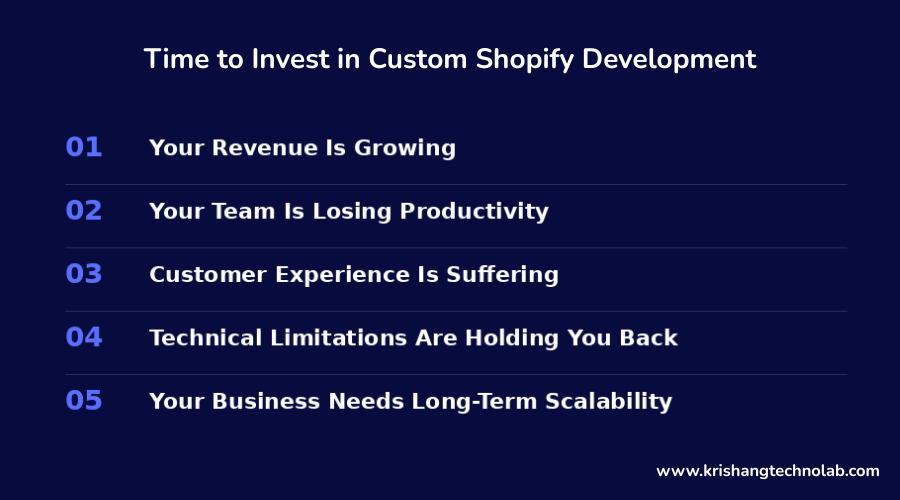
Sometimes the signs are not dependent on one feature. They are tied to your overall business trajectory. Here are five more general signs that custom Shopify development is the right move.
Your Revenue Is Growing
Sales are rising and often break a standard setup. More orders mean more strain on inventory, fulfillment, and checkout systems. If your store can’t meet demand, that’s a strong sign. Your Shopify foundation needs to grow as your revenue does.
Your Team Is Losing Productivity
Manual data entry takes hours. Repetitive updates on orders and workarounds for missing features also take considerable time. It is possible to automate these tasks with custom Shopify development services. This lets your team focus on the work that really matters instead of fighting for your platform.
Customer Experience Is Suffering
Slow pages take away customer satisfaction. Clunky navigation does too. Limited personalisation does too. If your shoppers are abandoning carts or complaining about checkout, then your store experience is not meeting your customer’s expectations. This is often evident when comparing platforms like WooCommerce vs Shopify.
Technical Limitations Are Holding You Back
At some point in the life of every business, its platform can’t support an idea. Perhaps it’s a unique product configurator. Maybe it’s a non-standard pricing model. If you’re finding the same technical wall, then custom software development is probably what you need.
Your Business Needs Long-Term Scalability
A store designed for today’s traffic might not be able to survive two or three years. Custom Shopify development for growing businesses builds in flexibility from the start. It also builds in scalable architecture. This helps you avoid another costly rebuild down the road.
Best Practices Before Starting a Custom Shopify Development Project
Good planning is key to a successful custom build. Good execution is important too. Indeed, these best practices ensure that your project consistently delivers business value over the long term.
Define Clear Business Goals
First, determine what you want custom development to do. Maybe you need faster load times. Maybe you need a more robust B2B workflow. Or, you might want to do more conversions. Clear goals keep the project on track. That makes it easier to measure success after you launch.
Audit Your Current Shopify Store
Review your current theme, apps and integrations.Understand what delivers the best outcomes. Then, work on the areas that you need to improve. An exhaustive audit reveals more tools, pages that are slow to load, and features that are absent. The audit also highlights the necessary improvements in custom development for Shopify stores. This process closely resembles establishing a Shopify eCommerce store from scratch.
Prioritize Business Requirements
You don’t need to roll out all features at once. Prioritize your needs based on business impact. In this way, you can use time and money to make the most valuable changes. Instead, put off lower-priority features until later.
Plan Integrations Early
Connecting to ERP, CRM, inventory and payment systems often takes more time than the shopfront. Plan for these integrations early. So there is no lag. It also helps to keep your Shopify development project on schedule.
Focus on Performance
Speed should be prioritized from the very beginning. Don’t wait. Make it part of the development process. Build with Shopify speed optimization in mind. As your store grows, so will you’re Core Web Vitals and search rankings. Plus, hiring Shopify SEO experts can help take your results even further.
Choose an Experienced Shopify Development Partner
The effect of partnering with expert Shopify developers can be huge. It’s also important to find a reliable Shopify development agency. Search for a partner that knows your industry. Look at their history of successful custom builds.
Test Thoroughly Before Launch
Check your store across multiple devices and browsers. Also see the real customer journeys. And finally, review all the important features before launch. This helps to find problems before customers do. This way, it saves your revenue and your reputation. Testing is even more important for high-traffic stores or stores with complex checkout flows.
Plan for Future Growth
Create your store for the future, not just for today. A good custom Shopify development project makes it easy to add new features supporting new markets and integrations; your store can grow without major changes. Shopify store maintenance is an ongoing process to keep things running after launch.
Conclusion
Outgrowing a regular Shopify setup is a normal part of business growth. One disadvantage is less design flexibility. Then there’s app overload. Operational inefficiencies and performance issues matter, too. They all mean your store needs more than a theme can give. Custom Shopify development is more than just adding more features. It’s about creating a high-performance, scalable store that works for your business, not the other way around.
Compare your current store to the signs above. If even a few of these sound familiar, it may be time to reach out to shopify experts. You can also look for custom Shopify development company that will help your business in the long run.
Frequently Asked Questions
What is Custom Shopify Development?
It is the process of building custom integrations, themes and features on Shopify. These are in addition to what typical themes and apps offer. So they are created to meet the needs of one particular enterprise.
How is Custom Shopify Development different from Shopify customization?
Basic customization usually involves changing the design of an existing theme. Custom Shopify development, however, means writing new code. That means it creates features, integrations or workflows that aren’t available in standard themes or apps.
Is Custom Shopify Development worth it for small businesses?
It can be. This is particularly the case, for instance, for small businesses with unique product needs or specific workflow problems. Also, there are lots of cheap, low-competition ways to do Custom Shopify Development for small businesses.
How much does Custom Shopify Development cost?
Costs can vary dramatically by project scope. For example, a few custom features can cost less than a complete headless rebuild. Therefore, you will get an estimate based on your needs from a Shopify development company.
Can Custom Shopify Development improve SEO?
Yes. Faster loading times help. Core Web Vitals are improved. The better code structure helps too. All three combined support better Shopify SEO optimization.
Does Custom Shopify Development improve website speed?
Yes, in most cases. Deleting unnecessary apps helps. Building an optimized, custom code also helps. This often results in major improvements in the speed of Shopify stores.
When should I hire a Shopify development company?
Be aware of the 10 signs above. One is slower performance. Another issue is app overload. B2B complexity and scaling issues are important too. If you see these signs, it’s a beneficial time to bring in Shopify development services.
Found this post helpful? Don't forget to share it with your network!