Quick Overview: Mobile app development cost in 2026 ranges from $15,000 for a simple MVP to $300,000+ for a complex, enterprise-grade app. This guide breaks down real pricing by app type, platform, and features plus hidden post-launch costs so you can budget your app project with confidence.
If you’ve started researching app development, you’ve probably noticed the numbers are all over the place; one website says $10,000 and another says $300,000. Both can be true at the same time, because mobile app cost depends entirely on what you’re building, not just that you’re building “an app.”
This guide breaks down real 2026 pricing by app complexity, app type, platform, and feature set, plus the hidden costs most businesses forget to budget for. By the end, you’ll be able to look at any agency quote and know whether it actually makes sense.
Quick Answer: Average Mobile App Development Cost in 2026
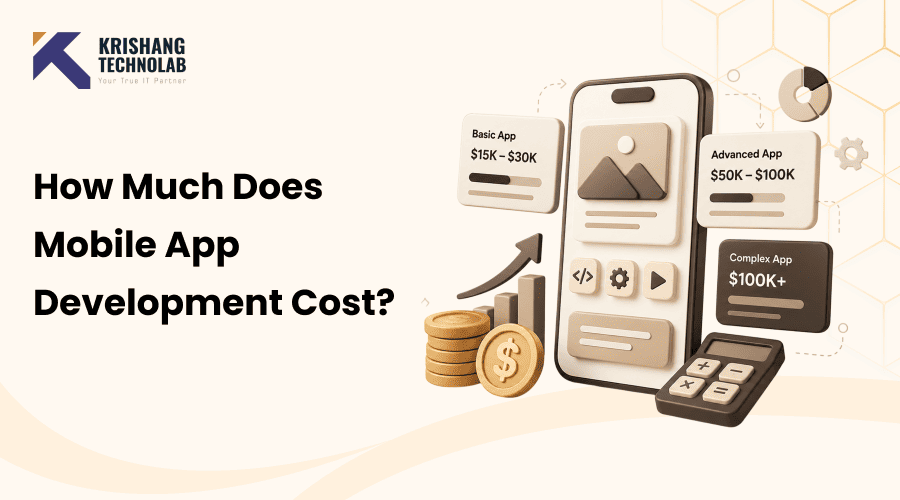
The average mobile app development cost in 2026 ranges from $15,000 to $300,000+, depending on the complexity of the app:
| App Complexity | Estimated Cost | Timeline |
| Simple app (basic MVP) | $10,000 – $30,000 | 6–10 weeks |
| Medium complexity app | $25,000 – $150,000 | 3–6 months |
| Complex / enterprise app | $150,000 – $300,000+ | 6–12 months |
These ranges cover design, development, testing, and launch. They don’t include ongoing expenses such as maintenance, hosting, and marketing. We’ll go over those later in this guide.
What Is Mobile App Development Cost?
The mobile app development cost is the total cost to design, build, test and launch a mobile application. It’s not just a line. It’s a mix of a number of workstreams: research and planning, UI/UX design, frontend and backend development, API integrations, quality assurance and app store deployment.
When people ask, “How much to make an app” they usually only think of the coding part. The fact is that coding is only one part of the total cost of mobile development. Design choices, the number of user roles and the number of third-party services your app needs to communicate with (payment gateways, maps, push notifications) will influence the end number.
Mobile App Development Cost by App Complexity
The single biggest driver of cost is complexity. How many screens, how much custom logic, and how many integrations your app needs.
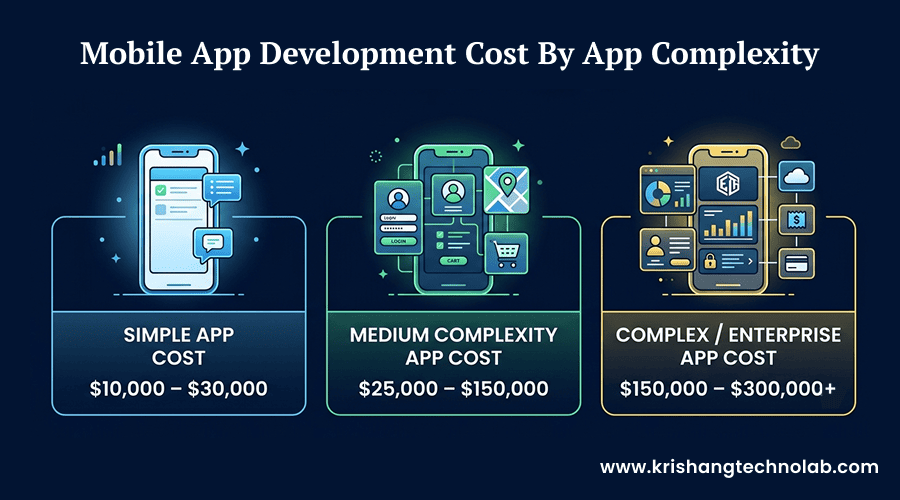
1. Simple App Cost (Basic Features)
Estimated cost: $10,000 – $30,000
Simple apps might have a basic login system, a few static or semi-dynamic screens, a simple profile and minimal backend logic. Think of a simple booking form. This is an app that has limited features for providing information. An internal company tool. Most of these apps don’t require a lot of heavy lifting on the back end or complex third-party integrations.
2. Medium Complexity App Cost
Estimated cost: $25,000 – $150,000
Medium-complexity apps include custom UI components, API integrations (Google Maps, payment gateways), user-generated content, push notifications, and a more capable backend. Most business apps, food delivery, fitness tracking, and service marketplaces fall into this bracket.
3. Complex / Enterprise App Cost
Estimated cost: $150,000 – $300,000+
Complex apps have real-time data sync, AI/ML capabilities, a multi-role permission system, high-level encryption and integration with multiple internal systems. You will usually find Fintech platforms, healthcare apps with compliance requirements and large-scale marketplaces here.
Not sure what tier your idea falls under? Our team can scope it out for you. We make complexity simple during the discovery phase with our mobile app development services.
Mobile App Development Cost by App Type
Beyond complexity tiers, the category of app you’re building has its own typical cost range, since each type has its own non-negotiable features.
1. Ecommerce App Development Cost
Estimated cost: $20,000 – $150,000
E-commerce apps need a product catalog, search and filtering, a cart and checkout, payment gateway integration, order tracking and often inventory sync with a backend system. Costs can soar if you add on AI-driven recommendations or AR “try-before-you-buy” features. If you’re building a storefront as well as a companion app, our e-commerce development services cover platforms like Shopify, WooCommerce, and Magento as well as mobile.
2. On-Demand / Booking App Cost
Estimated cost: $25,000 – $130,000
On-demand apps (food delivery, service booking, ride-hailing style apps) require real-time location tracking, in-app payments, scheduling logic and often two separate apps (one for customers, one for providers/drivers).
3. Social Media App Cost
Estimated cost: $30,000 – $200,000
Social apps require real-time messaging, media upload and storage, content feeds, notifications, and moderation tools. Scalability planning matters a lot here since user growth can spike fast.
4. Fintech / Healthcare App Cost
Estimated cost: $40,000 – $300,000+
These apps carry the highest cost because of compliance requirements (PCI-DSS for fintech, HIPAA for healthcare), encrypted data handling, audit trails, and often integrations with banking or insurance systems.
Cost to Build an App by Platform (Android, iOS, Cross-Platform)
Your platform choice affects both cost and timeline:
- Native Android: Built specifically for Android using Kotlin or Java. Best performance on Android devices, but you’d need a separate build for iOS. Learn more about our Android app development services.
- Native iOS: Built using Swift specifically for Apple devices. Same trade-off excellent performance, but iOS-only. See our iOS app development company page for details on our process.
- Cross-platform (Flutter / React Native): One code base that runs on both Android and iOS, which can reduce development cost significantly compared to building two native apps separately. Our Flutter app development and React Native development services are both strong options here, depending on your performance needs and existing tech stack.
For most startups and SMEs validating an idea, cross-platform development is the more budget-friendly route since it avoids duplicating work across two codebases.
Key Factors That Affect Mobile App Development Cost
1. App Features & Functionality
Every feature, login, chat, search, push notification, and payment adds development time, testing effort, and backend logic. A feature list with 10 items will always cost less than one with 30, even within the same complexity tier.
2. UI/UX Design Complexity
Branded design systems, custom animations, and highly interactive interfaces take more time to design and develop than templated layouts. Design isn’t just about looking good, it’s a direct factor in retention so it’s rarely worth cutting corners here.
3. Backend & API Integrations
Apps that rely on real-time data, multiple third-party APIs (maps, payment gateways, CRMs), or custom backend logic require more engineering hours than apps that mostly display static content.
4. Developer Location & Hourly Rates
Hourly rates vary widely by region. North American and Western European agencies often charge much higher hourly rates than teams in South Asia or Eastern Europe, though quality can be just as good in the lower-cost regions if you choose the right partner.
5. Team Structure (In-House vs Agency vs Freelancer)
- In-house team: Highest control, highest fixed cost (salaries, benefits, infrastructure).
- Freelancers: Lower cost upfront, but higher risk around consistency, communication, and long-term support.
- Agency: Balanced option you get a full team (design, development, QA, project management) without the overhead of hiring internally.
If you want flexibility without committing to a full in-house team, you can hire dedicated developers who work specifically on your project under your direction.
6. Platform Choice (Android, iOS, or Both)
Developing for Android and iOS roughly doubles the native development effort since each platform has its own codebase, design guidelines, and testing requirements. Cross-platform frameworks reduce this gap significantly, and that is why choosing a platform is on every cost-planning checklist.
7. App Maintenance & Scalability Requirements
How you plan to scale affects cost from day one. An app designed to handle a few thousand users costs less to build than one designed for rapid scaling, real-time sync across regions, or heavy concurrent traffic even if the feature list looks identical on paper.
8. Third-Party Tools & Licensing Costs
Premium APIs, mapping services, analytics platforms, and some UI component libraries come with their own licensing or usage-based fees. These are easy to overlook during planning but can add up meaningfully over a year of active use.
9. Security & Compliance Requirements
If your app handles payments, health records or personal data, you will require encryption, strong authentication, and sometimes formal compliance audits (PCI-DSS, HIPAA, and GDPR). These requirements add to development time and ongoing review cost, but skipping them is not realistic for regulated industries.
10. Number of User Roles & Permission Levels
An app with a single user type is far simpler than one with multiple roles for example, a marketplace app needing separate flows for buyers, sellers, and admins. Each additional role typically means its own screens, permissions, and testing scenarios.
11. Post-MVP Iteration & Feedback Cycles
Costs don’t stop at launch. Plan for at least 1 or 2 rounds of post-launch refinement based on real user feedback. This is often where an app begins to really convert and retain users through these iterations.
Learn More: Top 11 Mobile App Development Platforms
Mobile App Development Step-by-Step Cost Breakdown (Stage-Wise)
Mobile application development cost isn’t paid out in one lump sum; it moves through five distinct stages, each with its own budget share, deliverables, and risk factors. Understanding what happens (and what can go wrong) inside each stage makes it much easier to read an agency’s quote and spot where your money is actually going. Here’s a quick breakdown of where the money goes, followed by a deeper look at each stage.
| Stage | What It Covers | % of Total Budget | Typical Duration |
| Discovery & Planning | Requirement gathering, technical feasibility, scope definition, tech stack selection | 5–10% | 1–3 weeks |
| UI/UX Design | Wireframes, prototypes, final visual design, design system | 15–20% | 2–6 weeks |
| Development | Frontend, backend, database, and API integration work | 50–60% | 8–20 weeks |
| Testing & QA | Functional, performance, security, and device-compatibility testing | 10–15% | 2–4 weeks |
| Deployment & Launch | App Store / Play Store submission, developer account fees, final configuration | 3–5% | 1–2 weeks |
Stage 1: Discovery & Planning
Estimated cost: $2,000 – $15,000
This stage turns a rough idea into a documented plan. It typically includes competitor research, defining your target users, writing out a feature list, choosing a tech stack, and producing a project roadmap with timelines and milestones. For more complex apps (fintech, healthcare, multi-role marketplaces), discovery also covers compliance research and early architecture decisions, since these affect almost every later stage.
The discovery phase is also where most budget overruns are prevented or created. A rushed discovery phase often means requirements get “discovered” mid-development instead, and changes made after coding has started cost far more than changes made on paper.
Stage 2: UI/UX Design
Estimated cost: $5,000 – $40,000
Design work happens in layers: low-fidelity wireframes first (basic layout and flow), then high-fidelity mockups (actual visual design colors, typography, branding), and interactive prototypes that simulate how the app will feel before a single line of production code is written.
Cost here scales with the number of unique screens, how custom the visual design is versus using standard UI patterns, and whether you need separate design systems for multiple user roles (e.g., a customer app and a separate driver/admin app). Apps with heavy animation or highly branded interfaces sit at the top of this range.
Stage 3: Development
Estimated cost: $20,000 – $200,000+
This is the biggest line item because it covers three parallel workstreams:
- Frontend development: building the actual screens and interactions users see for each platform you’re targeting.
- Backend development: servers, databases, business logic, and the APIs that make the app work behind the scenes.
- Third-party integrations: payment gateways, maps, push notification services, AI APIs, and any other external systems that your app uses.
Feature count and complexity, rather than time alone, primarily drive costs at this stage. A real-time chat feature or live location tracking takes a lot more engineering effort than a static profile screen, even though both might look like “one feature” on a project brief.
Stage 4: Testing & QA
Estimated cost: $5,000 – $30,000
Quality assurance covers functional testing (does every feature work as intended), performance testing (does the app stay responsive under load), security testing (can data be exposed or exploited), and device/OS compatibility testing across different phones, screen sizes, and operating system versions.
Testing is frequently the stage that gets compressed when a project runs behind schedule, which is exactly backwards, since bugs caught after launch are more expensive to fix and directly damage user trust and app store ratings.
Stage 5: Deployment & Launch
Estimated cost: $500 – $5,000
This is the smallest cost line, but it’s the final gate before users can actually download your app. It includes preparing app store listings, submitting builds for Apple and Google review, configuring production servers, and handling any compliance documentation the app stores require. App store review can take anywhere from a day to a couple of weeks, and rejected submissions (often due to missing privacy policies or incomplete metadata) can quietly push back your entire launch timeline, so it pays to prepare this stage early rather than at the last minute.
Read About: How to Choose the Right Tech Stack for Mobile Apps
Hidden & Ongoing Mobile App Costs After Launch
Launch day isn’t the finish line; it’s the start of an ongoing budget line. Many businesses focus only on the initial build and get caught off guard by what comes after.
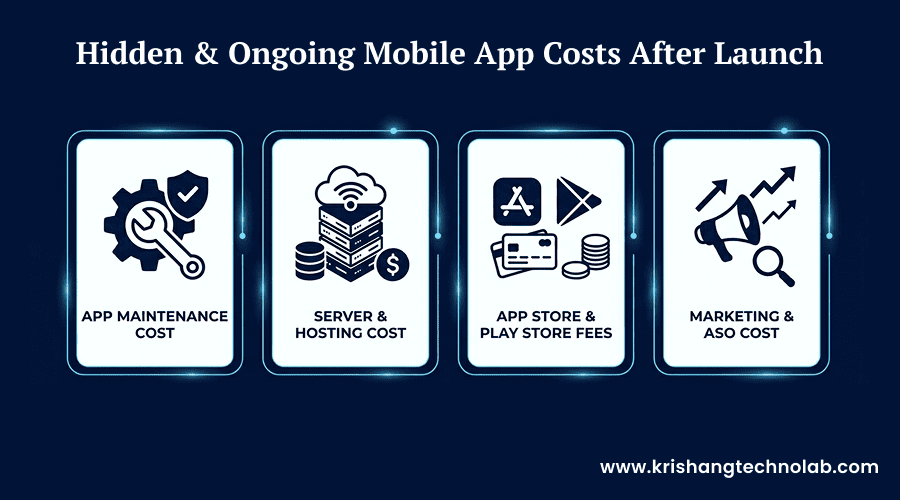
1. App Maintenance Cost
Bug fixes, OS compatibility updates, and minor feature improvements typically cost a percentage of your original build cost annually. Skipping maintenance is one of the fastest ways an app starts losing users.
2. Server & Hosting Cost
Cloud hosting costs scale with your user base. What is cheap at launch can be expensive once you have a larger, more active user base. Not surprising, but inevitable.
3. App Store & Play Store Fees
Apple charges a yearly developer program fee, whereas Google only requires a one-time registration fee to the Play Console. Both are small compared to development cost but easy to forget when budgeting.
4. Marketing & ASO Cost
A great app nobody finds is a failed app. ASO Budget App Store Optimization (ASO) Optimizing your title, keywords, screenshots and description so people can actually find your app organically.
How to Reduce Mobile App Development Cost Without Compromising Quality
Controlling costs is not about removing features but about better sequencing them.
The best thing is to build an MVP (Minimum Viable Product) first. Launch with only the core features you need to test your idea with real users and grow based on real feedback, not assumptions. This reduces the initial cost, shortens time to market and reduces the risk of spending months building features nobody ends up using.
If you decide to go down this route, our guide on how to build an MVP takes you through the whole process, step by step. Our detailed breakdown of MVP development cost gives you specific numbers to plan around.
Other ways to control cost without sacrificing quality are:
- Choose cross-platform frameworks over building two separate native apps
- Use existing APIs (payment, AI, maps) instead of building custom systems from scratch
- Prioritize ruthlessly; not every feature needs to launch on day one.
- Get a detailed, itemized quote so you know exactly what you’re paying for.
How to Choose the Right Development Team for Your Budget
The cheapest quote is not always the cheapest app. A low starting price can become a much higher total price if the build has to be redone due to poor code quality, missed deadlines or lack of post-launch support.
When selecting a development partner, look at their portfolio in your app category, ask how they deal with scope changes, and find out what is included in maintenance after launch. In our article on how to select the right mobile app development agency, we discuss the specific questions you should ask before signing any contract.
Real-World: Popular Mobile Apps and Their Estimated Development Cost
Looking at well-known apps helps put abstract pricing ranges into perspective. Here’s what it would cost to build something similar to three popular app categories today, not the original company’s actual budget (those scaled over years with huge engineering teams), but a realistic estimate for building a comparable app from scratch in 2026.
| App Type (Inspired By) | Core Features | Estimated Cost (2026) |
| Ride-hailing app (like Uber) | Real-time GPS tracking, in-app payments, rider/driver apps, dynamic pricing | $30,000 – $130,000+ |
| Dating app (like Tinder) | Swipe-based matching, real-time chat, geolocation, AI-based matching, video calls | $25,000 – $150,000+ |
| Food delivery app (like Zomato/Swiggy style) | Restaurant listings, cart & checkout, live order tracking, delivery partner app | $40,000 – $150,000 |
A couple of things to take away from these numbers:
- The biggest cost swings within each category come from advanced features: AI matching, real-time tracking, and video calls each add their own separate budget line.
- Building a single-platform MVP version of any of these apps costs significantly less than a full multi-app ecosystem (customer + provider + admin apps).
- Development team location remains one of the largest cost levers; the same feature set can cost 2–4x more depending on whether you hire in North America/Western Europe versus South Asia.
How Krishang Technolab Can Help Estimate Your App Development Cost
Generic cost ranges are useful for early budgeting, but they cannot tell you what your specific app will actually cost, which depends on your exact features, integrations, and growth plans. This is where having an experienced team working for you means the difference between a wild guess and a number you can actually plan around.
At Krishang Technolab, cost estimation is considered part of the discovery process, not a sales pitch:
- Detailed requirement analysis: We break your idea down into specific features and user flows before quoting anything, so the estimate reflects your actual app, not a generic template.
- Transparent, line-item quotes: See exactly what you’re paying for design, development, QA, and deployment all listed separately with no hidden line items added later.
- Platform & framework guidance: Our team helps you decide between native (Android, iOS) and cross-platform (Flutter, React Native) based on your budget and performance needs, not a one-size-fits-all recommendation.
- MVP-first planning: If your budget is limited, we help you sequence features so you launch with a working core product first, then expand based on real user data. See our MVP development cost breakdown for specifics.
- Flexible engagement models: Whether you need a full project team or want to hire dedicated developers to extend your team, we structure the engagement around your budget rather than forcing a fixed package.
If you want a number specific to your idea rather than a general range, you can request a free project quote and get a detailed breakdown based on your actual requirements.
Final Thoughts: Budgeting for Your Mobile App Project
There’s no single correct answer to “How much does mobile app development cost?” But there is a right way to get a good number for your specific idea: identify your core features, determine your platform strategy, and get a detailed quote that breaks down the cost of design, development, testing, and post-launch separately.
The businesses that budget successfully are the ones that plan for the full lifecycle of the app, not just the initial build from the first wireframe to the marketing spend after launch.
Found this post helpful? Don't forget to share it with your network!