Quick Overview: AI development for startups helps businesses turn ideas into scalable products using AI development services, AI MVP development, generative AI, machine learning, and AI agents. This guide covers the AI development process, technology stack, costs, security, deployment, scaling, and 2026 AI trends to help startups build reliable, production-ready solutions.
AI development for startups has moved from a nice-to-have to a survival skill. Founders now compete against rivals who ship AI-powered startup solutions in weeks, not years. As a result, understanding AI development for startups is no longer optional for anyone building a modern product.
However, most founders still face one simple question. How do you turn an AI idea into a working product? Between choosing models, managing data, and controlling AI development costs, the path can feel overwhelming. Consequently, many promising ideas stall before reaching real users.
Here’s your guide for the full AI development life cycle for startups. It’s specifically about validating your idea, building an AI MVP, and choosing the right tech stack. It also covers the team structure, security, common mistakes, and 2026 trends that are shaping the market. Along the way, it also breaks down realistic AI development cost expectations for early-stage teams.
You will have a clear understanding of how AI development for startups functions by the end. This roadmap offers a clear, practical starting point for AI development for startups. It applies whether you build in-house or hire outside help.
What Is AI Development for Startups?
AI development for startups is designing, building, and deploying AI features in a lean environment. That process is data-based and iterative, unlike traditional software. This means that building AI for a startup requires different skills and timelines.
AI lets you automate, personalize, and make smarter decisions at a scale that small teams could never achieve manually. For example, a two-person startup can now do things that used to require big data teams to recommend. Thus, the emergence of AI startups has truly equalized the competitive landscape.
Startups typically rely on a core set of AI technologies to build smarter products. Machine learning drives predictions, while generative AI development services power rapid content creation and natural conversations. Natural language processing handles text, computer vision processes images, and AI agents automate tasks, forming the foundation of modern AI solutions for startups.
Why Should Startups Invest in AI Development?
AI development for startups delivers measurable business value, not just technical novelty. Specifically, AI helps founders do more with fewer resources. Below are the core reasons why startups continue to invest here.
AI removes the repetitive work for support and ops teams, such as chatbots that answer common queries automatically. Meanwhile, personalization engines customize offers to individual users so that customers feel understood. So, the lifetime value and retention will often increase.
AI models also analyze large data sets faster than any human team, providing sharp pricing and product decisions. Automation also reduces the overall operating expenses across the organization. Building a custom AI also results in proprietary features that others can’t easily replicate, creating a sustainable advantage for you. And finally, artificial intelligence systems can do more and more work without having to increase headcount accordingly, and that’s something investors love.
How to Turn an AI Idea Into a Production-Ready Product
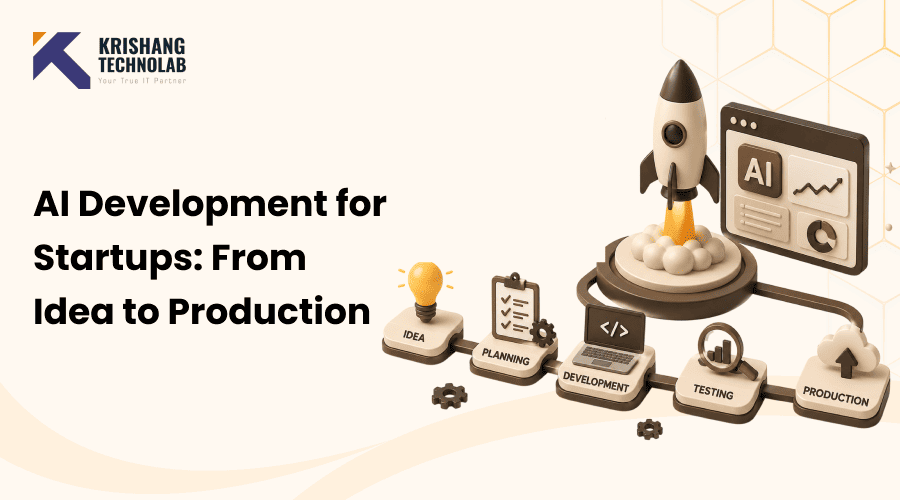
The AI development process for startups takes an idea from validation to a live, production-ready product. Each step builds on the previous one, creating a reliable AI development roadmap for startups.
Validate Startup Ideas Before MVP by starting with a genuine business problem rather than a specific technology; otherwise, teams may build AI solutions nobody needs. Put the idea to the test through market research and feedback from real customers, then define clear functional and technical requirements covering security, scalability, and compliance.
Then decide your development approach. Startups have the option to build their own models, utilize existing ones, invoke APIs, or fine-tune pre-existing systems. APIs are the solution for most early teams looking to keep the cost of AI development in check. Once you’ve made your decision, pick frameworks and cloud platforms that fit with your goals.
Choose the stack and build an AI MVP around 1 core feature. Test it thoroughly. It is then deployed using CI/CD pipelines, monitoring, and security checks. Finally, keep monitoring and optimizing because this step never really ends.
How to Build an AI MVP for a Startup
An AI MVP allows startups to test core functionality without making a large upfront investment. An AI MVP development agency can focus on one key assumption at a time, reducing risk during the early stages of product development.
Core features, a simple interface, and basic feedback loops. Strong AI MVP But a full product has deeper integrations and more features. So think of the MVP as a starting point, not a finished product.
Most AI MVP development projects take 6 to 16 weeks. But timelines will be very data-readiness- and complexity-dependent. Off-the-shelf MVPs with APIs are usually faster to release than custom-trained ones.
Choosing the Right AI Technology Stack
This is a serious decision to make as the choice of technology influences performance and cost in AI development for startups. For simpler problems, Scikit-learn is suitable, and for building custom models, we use TensorFlow and PyTorch.
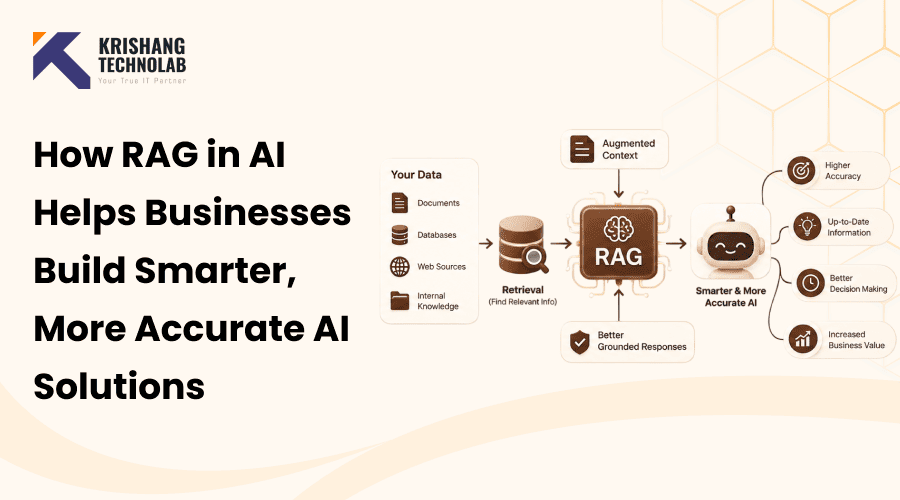
Generative AI for startups often relies on large language models (LLMs) and embeddings to create intelligent applications. Retrieval-augmented generation connects these models with company data, while LLM vs Generative AI: A Complete Guide explains how these technologies differ and where each fits into modern AI solutions. Properly designed APIs also make AI integration more flexible as startups expand their features and products.
AI applications need the computing power and scalability that cloud platforms can provide. Thus, most startups are building AI applications on cloud-first architectures today.
Data Strategy for AI Startup Development
An AI application’s reliability depends on the quality of its data, so a clear data strategy should be planned from day one. Data Science Strategy Consulting can guide startups in identifying relevant data sources, cleaning the information, and structuring it for effective AI development.
Bad data quality affects model accuracy directly, so the early errors should be caught by validation. Adequate storage, in contrast, means data is organized and safe, and clear policies prevent version conflicts.
When you build an app that handles user data, there are privacy regulations you’ll want to watch out for. Startups have to bake compliance into their data pipelines from day one.
AI Model Development and Integration
Model choices affect performance and long-term cost. Custom models provide the most control but need a lot of data; pre-trained models are faster to deploy and less costly. Hence, most startups start with pre-trained models first.
Training means building models from scratch, while fine-tuning adapts existing models for specific use cases and is far more efficient. RAG vs. Fine-Tuning for Enterprise AI provides a clear view of how these approaches fit different business requirements. Models can then connect to real-world features through APIs, while rigorous testing helps prevent downstream failures.
Finally, continuous evaluation measures accuracy and reliability using real-world data. Model shift is found before it affects users.
How Much Does AI Development for Startups Cost?
One of the most common questions founders ask before they begin AI development for startups is the cost of AI development. It varies a lot by scope and approach. The costs for AI development are not fixed and depend on a number of factors, including:
- Product complexity
- AI model and data requirements
- Development team size
- Integrations and cloud infrastructure
- Security, testing, and maintenance
Startups can reduce costs by launching an MVP instead of a full product, allowing them to validate core ideas before making larger investments. MVP vs Full Product: A Guide for Founders outlines how choosing the right development approach can keep AI projects focused and cost-effective. Clear feature prioritization also helps control overall AI development costs without unnecessary complexity.
Building the Right AI Development Team
Team structure is a core part of any successful AI development for startups’ efforts. The right team makes the difference between a stalled project and a launch. AI/ML engineers design and refine models, forming the technical core of most teams. Meanwhile, AI developers are packaging those models into working apps.
Data engineers build the pipelines that feed AI models with new, clean data. Backend developers write the code that makes it all function. UI/UX designers determine how the AI features are experienced. “Good design produces good AI outputs.”
DevOps and MLOps engineers deploy and automate to keep stability at scale. Product managers also align AI development with real-world business goals.
How to Choose an AI Development Company for Your Startup
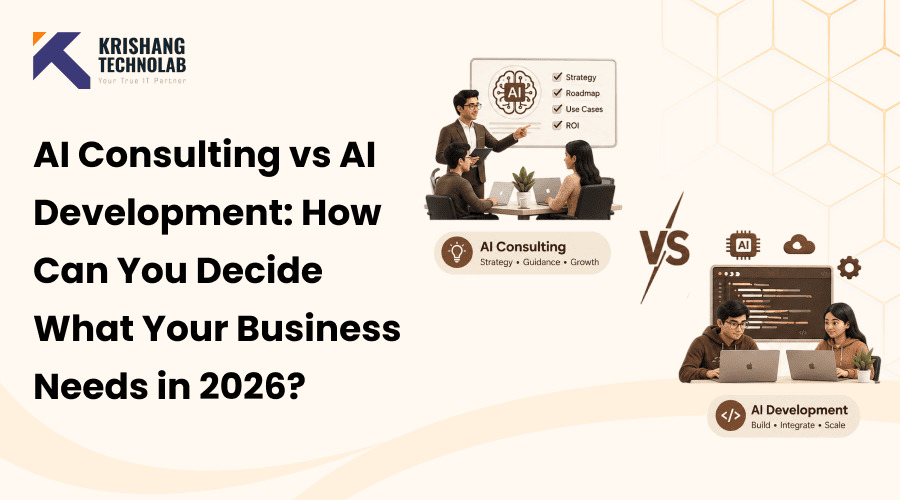
Many startups prefer to invest in AI development services rather than building an in-house AI team. However, choosing the right development partner requires careful evaluation of technical expertise, experience, scalability, and project requirements.
First look at technical depth and ask about experience with your particular use case. Next, look at case studies and prior work of AI product development in a similar scope. Think about the team’s communication as well: Clear processes prevent miscommunication.
Technical skill is important, but so are practices for security and scaling. Lastly, look at the pricing models and after-sales service. Some custom AI consulting services for startups offer maintenance while others don’t.
AI Application Architecture for Startups
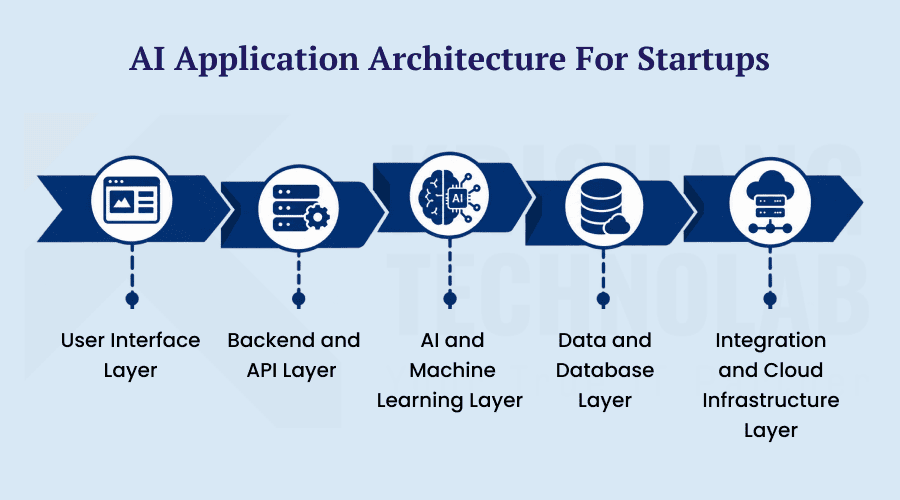
Scalable architecture helps you keep performance reliable as your AI products grow. In this architecture, several separate layers work together. In real life, teams can make systems more reliable through knowledge of each layer.
1. User Interface Layer
The interface layer handles the direct interaction of the user with AI features. But it must also be able to clearly and intuitively present the outputs of AI. Good interface design creates user trust in AI-driven results.
2. Backend and API Layer
This layer connects the user interface with the underlying AI models and services. Web software development services handle requests, authentication, and data flow, while a robust backend architecture ensures stable and scalable AI application development.
3. AI and Machine Learning Layer
AI and Machine Learning Layer has models that predict, generate content, or recommend. It takes inputs and outputs to the back end. This is the performance that will make or break the product.
4. Data and Database Layer
Data and Database Layer stores and manages the data models rely on. Indeed, it supports both real-time queries and historical analysis. At the same time, well-structured data storage improves model accuracy over time.
5. Integration and Cloud Infrastructure Layer
This layer holds together external services, APIs, and cloud tools. It gives the AI models the computer power they need. So this layer controls how big the system can be.
Testing and Quality Assurance for AI Applications
AI products require both traditional testing and AI-specific evaluation. Functional testing verifies that the product functions as expected, and performance testing assesses the product’s speed and stability.
A machine learning development company typically uses AI model and output testing to determine whether responses remain accurate, reliable, and safe, including in edge cases. Security testing then identifies vulnerabilities in data handling and strengthens user trust.
User acceptance testing is where actual users sign off that the product is useful, preferably before each major release. Finally, ongoing monitoring assists in preserving accuracy post-deployment by detecting early drift and degradation.
AI Security and Responsible Development
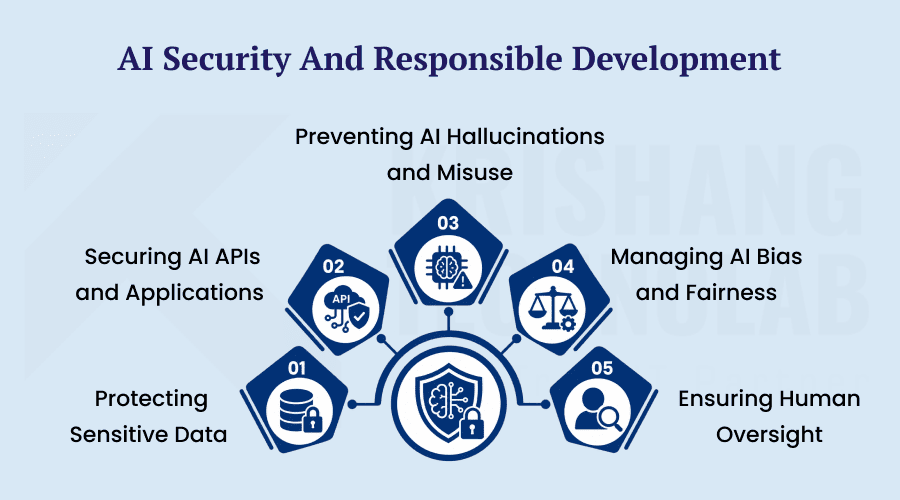
Startups need to embed security, privacy, and a Responsible AI framework into their products from the very start. Sensitive data is protected by strong security and ethical AI practices that help reduce bias, misuse, and untrustworthy results. Early attention to these concerns can help startups reduce risks, meet regulations, and build user trust over time.
1. Protecting Sensitive Data
Sensitive data needs to be encrypted and access controlled and stored securely. It also means that less data collected equals less total risk exposure. In turn, these practices protect both the users and the company.
2. Securing AI APIs and Applications
APIs need authentication, rate limiting, and regular security audits. Throughout time, unsecured APIs allow attackers easy access. Security, therefore, should be built in, not added later.
3. Preventing AI Hallucinations and Misuse
Generative artificial intelligence systems can generate incorrect or misleading outputs. These risks are mitigated by clear guardrails and output validation. Thus, careful design is effective in preventing most misuse before it happens.
4. Managing AI Bias and Fairness
When training data is biased, it can cause outcomes that are biased or unfair. Real-life checks find these and fix them all the time. When AI systems work well, users believe them more and for a longer time.
5. Ensuring Human Oversight
Human supervision is still required even in highly automated systems. “People should have the opportunity to review high-stakes AI decisions before they’re deployed.” This balance is what makes artificial intelligence systems trustworthy and accountable, in fact.
Deploying an AI Product to Production
There is no easy way to go to production. “There is no stable environment that can copy the real world.” He said that teams should first test in staging.
Continuous integration and delivery automate testing and deployment, allowing faster releases and fewer errors. At the same time, models need careful version control, and rollback plans should be in place for when problems arise.
Once the app is live, use monitoring tools to keep an eye on both performance and the cost of the infrastructure. In the end, regular maintenance helps keep systems running well as they are used more often.
How to Scale an AI Product After Launch
More use means new technical challenges. The infrastructure needs to scale with the number of users, and cloud platforms make this much easier. During rapid growth, however, teams should continue to monitor the costs.
Latency-reducing optimization is becoming increasingly important, as faster models improve user experience at scale. More usage often means more costs. Costs are watched carefully to keep them from getting ahead of revenues.
Finally, real user feedback should be used to determine what features to add next so the expansion is targeted and effective.
Common AI Development Challenges for Startups
When building AI for startup projects, startups often face several common challenges. With limited budgets, teams can only build so much initially. That’s why the MVP approach is so important. Likewise, bad data will affect model performance, so it’s important to invest in quality from the start.
Talented AI professionals are still limited in supply; many startups address this by teaming up with an outside AI development company. Simultaneously, the cloud/API costs can spike unexpectedly if not monitored regularly.
Security and privacy need to be considered at all stages of development, not just at launch. Finally, there are new reliability issues introduced by scaling, but cloud infrastructure helps to deal with this growth.
Common Mistakes Startups Should Avoid
Avoiding the common mistakes will save you a lot of time and effort. Sometimes teams build AI features before determining whether there is any real demand for them, wasting dev effort. Simplicity should inform early decisions, as overbuilt MVPs also take longer to develop.
Costs of rework are often the consequence of choosing tools before knowing the requirements. Another common mistake is to ignore data quality, because bad data will silently sabotage even good models.
Many teams underestimate the ongoing costs and don’t think about security until it’s too late. And finally, there’s no monitoring of performance at launch, so problems aren’t caught until they’re brought up by users.
AI Development Trends Startups Should Watch in 2026
Keeping up with AI trends helps startups make smarter development decisions. 9 Types of AI Agents explains how AI agents are taking on complex, multi-step tasks while generative AI continues to advance content and code generation. As these capabilities grow, agent-based workflows are gaining traction across modern businesses.
Retrieval-augmented generation connects language models to company data to improve accuracy. In contrast, multimodal AI uses text, images, and audio to create richer product experiences.
And smaller, specialized models are making strides, often beating larger models on narrow tasks. There is also growing popularity for edge AI in real-time applications that require low latency.
Future of AI Development for Startups
The development of AI will likely continue at a rapid pace. More products will be built with AI from the ground up, not bolted on later. This change will revolutionize how startups think about product design.
AI agents will be able to do more complex things with less supervision. Meanwhile, infrastructure will still get cheaper and easier to access, reducing the barriers for early-stage startups.
Responsible AI practices will be a requirement, not an option. So startups that focus on this early on will earn trust in the long run.
FAQs
How much does it cost to develop an AI product for a startup?
The cost of building an AI product depends on the complexity, features, data requirements, integration with other technologies, and team size. Simple MVPs are less expensive than completely customized options that can grow with your business.
How long does AI development take for a startup?
How long AI making takes depends on factors like the complexity, the number of features, integration with other systems, and the amount of testing required. While complex solutions need much longer development cycles, a simple AI MVP usually takes six to sixteen weeks.
Should startups build their own AI model?
Most startups should not be building custom AI models at the start. Pre-trained models and APIs allow startups to validate ideas faster and cheaper before spending money on expensive model development.
What is the best AI technology for startups?
No single artificial intelligence (AI) technology is best for startups. The right choice depends on business goals, use case, data needs, budget, scalability, security, and desired product features.
How can startups reduce AI development costs?
For early-stage startups, there are several ways to cut the cost of developing AI, including building an MVP, using existing AI models, focusing on core features, optimizing cloud infrastructure, and foregoing unnecessary custom development.
Should a startup hire an AI development company?
Startups Should Hire an AI Development Company Because They Don’t Always Have the Right Skills In-House. Look at their portfolio, experience, technical skills, communication, price, ability to grow, and understanding of your business needs.
How do I turn an AI idea into a production-ready product?
Validate the business problem, set clear requirements, choose the right AI tools, make an MVP, test it thoroughly, deploy it safely, keep an eye on performance, and keep making the product better.
Conclusion
Building AI is not some far-fetched fantasy for startups; startups can achieve it today. This guide covers the journey from idea validation to MVP development, testing, and deployment. Each stage builds on the previous one.
Your technology, data strategy, and team structure directly influence the outcome. Meanwhile, strong security and responsible AI practices protect your business and users. Avoiding common mistakes, such as skipping validation or ignoring data quality, saves time and reduces costs. Likewise, for lean teams, picking the right AI development company for startups may significantly shorten this journey.
Looking forward, the impact of AI agents and retrieval-augmented generation will continue to shape the landscape. Startups that start lean, validate early, and monitor continuously will be better able to adapt to this change.
At the end of the day, three things make AI development for startups successful. It takes the right strategy, the right technology, and the right expertise. This roadmap is a clear, actionable base for AI development for startups. This is true whether you build in-house or partner externally. Do it right, and you can transform your AI idea into a reliable, production-ready product. And that can then lead to long-term growth for years to come for that product.
Found this post helpful? Don't forget to share it with your network!